ARTIST-PLACED PUBLIC DOCUMENT ART. citizen-placed public documents. answerability. THE LOCAL RULE OF LAW. courts as our last human place. the citizen methods
emerging art theory and constitutional theory
Adam Daley Wilson is a conceptual artist, emerging theorist, and appellate attorney. He is represented by ENGAGE Projects Gallery in Chicago.
About the current art theory and constitutional theory practice in 2026
This site begins to gather Adam Daley Wilson’s published theoretical work across art theory and constitutional theory.
His publications arise from a practice spanning conceptual art, appellate and constitutional law, art theory, jurisprudence, citizenship, public institutions, human judgment, and emerging questions concerning artificial intelligence and human meaning. A published work may begin within one field and lead into another: a legal question may become a theoretical inquiry, an artwork may generate a theory, or art and law may operate together as a civic or public-interest method.
The publications collected here therefore need not belong to a single discipline. They may include scholarly and theoretical articles, published essays, papers, legal and constitutional theory, art theory, artist writings, and other work that has entered public circulation through publication.
This distinguishes the site from Adam Daley Wilson’s broader writings, notes, research, working theories, and developing ideas elsewhere. This is a place for published work: ideas that have moved from an evolving practice into a public record.
Taken together, these publications document a body of thought developing across—and sometimes between—established categories.
current prePublished Work
Note re following the links: SSRN may present visitors with an “Are you a human?” verification screen. It can look unusual if you are not expecting it. It is part of the site’s measures against AI theft.)
The Citizen Methods: What a Citizen Can Do (2026)
Read “The Citizen Methods: What a Citizen Can Do” via SSRN
Conceptual Art as a Method for Interdisciplinary Research and Critical Analysis (2024)
Read “Conceptual Theory Art as a Method for Interdisciplinary Research, Hypothesis, and Critical Analysis” via SSRN
SSRN is short for the Social Science Research Network, owned by Elsevier, a global academic publishing and information company that publishes scholarly journals, books, databases, and research platforms. SSRN is Elsevier’s preprint platform for the public dissemination of scholarly research in almost all academic and scientific fields. It hosts more than 1.5 million preprints by more than 2 million researchers and academics worldwide.
Work posted to SSRN is screened through SSRN’s research-integrity processes, but note that pre-publication on SSRN does not itself mean that a paper has undergone the peer review associated with publication in a formal academic journal.
PENDING PUBLISHED WORK
Artist-placed public document art and courts as our last human place (forthcoming late 2026)
The artist’s theory and practice will be a chapter in a forthcoming art theory book titled Bureaucratic Realism. Adam Daley Wilson is a contributing author to Bureaucratic Realism, edited by Meg Duguid, Ted Hiebert, and Duncan MacKenzie and forthcoming from Noxious Sector Press (Toronto and Seattle) in late 2026. Contributors to Bureaucratic Realism include Amir Badri, Emma Bergman, Maura Brewer, Tom Burtonwood, Colleen McCulla, Ashok Mathur, Neil Daigle Orians, Troy Richards, Craig Saper, Luiza Testa, Hui-min Tsen, Elia Vargas, Jennifer Willet, and Adam Daley Wilson. Collectively, the contributors include practicing artists, academics and professors, curators, writers, researchers, critics, theorists, arts administrators, and interdisciplinary practitioners working across art, media, cultural theory, institutional critique, education, and related fields.
Daley Wilson’s contribution develops his theory and practice of artist-placed public document art in relation to courts as our last human place—work emerging at the intersection of conceptual art, public institutions, law, human judgment, and the use of actual public documents as an artistic and civic medium.
The publisher, Noxious Sector Press, an artist-run art theory publishing imprint, describes Bureaucratic Realism as an investigation of institutional aesthetics, procedural structures, and the symbolic and material realities of bureaucracy.
The publishing house publishes work situated between art, theory, and artistic practice and forms of intellectual inquiry outside traditional academic boundaries.
The forthcoming chapter will sit alongside Daley Wilson’s other pre-published and publicly circulating theoretical work, including his SSRN papers, as part of an expanding publication record across art, law, constitutional theory, civic thought, institutions, and human judgment. A book relating to the citizen methods evolution of this theory is anticipated in 2027.
About Adam Daley Wilson
Adam Daley Wilson (b. 1971) is a conceptual artist, appellate lawyer, and emerging art and constitutional theorist based in Portland, Maine. He is represented by ENGAGE Projects Gallery in Chicago.
His work moves among conceptual art, law, jurisprudence, citizenship, public institutions, human judgment, language, and artificial intelligence. His published and developing theories include citizen methods in constitutional republics; rights as civic methods; public-power behavior relative to constitutional principles and norms; answerability as a form of public reasoning; artist-placed public document art; courts as human institutions; and the preservation of human language, judgment, wisdom, and meaning-making in an age of artificial intelligence.
Daley Wilson’s theoretical work often develops through the same associative process that informs his art. Ideas may begin in legal practice and become artworks or theories; artworks may produce new theoretical questions; and art and law may operate together as forms of public-interest practice. Some projects therefore sit comfortably within established disciplines, while others develop between them.
His visual practice includes conceptual painting, large-scale installation, video, performance, legible text, and abstract personal writing systems. His work examines language, interpretation, cognition, institutions, and the ways human beings construct and assign meaning.
Daley Wilson studied at the University of Pennsylvania and Stanford Law School. His legal practice has included appellate litigation, constitutional law, First Amendment law, legal ethics, antitrust litigation, and United States Supreme Court briefing. His current legal and theoretical work increasingly concerns the conduct of public institutions, citizen participation in constitutional government, human and machine judgment, and the relationship between law, art, and public life.
His artwork is held in collections in New York, Los Angeles, London, Paris, Miami, and Chicago. His 2021 and 2023 solo exhibitions in Chicago were selected as Artforum “Must See” exhibitions. His work and exhibitions have contributed to his recognition in conceptual painting, text-based art, post-conceptualism, and activist art.
Daley Wilson is self-taught as an artist and has spoken openly about bipolar I as part of the history of his artistic and intellectual development. He also mentors emerging artists and has pursued legal and public-interest work involving artists’ rights, constitutional law, civil rights, and the rights of people with mental-health disabilities.
This site focuses on his published and forthcoming work: papers, chapters, essays, and other writing that has entered, or is entering, public circulation through scholarly, academic, artistic, or independent publishing channels.
Selected Press and Publications
Third solo show THIS IS POST-THEORY ART reviewed in New City Art (Chicago) June 26, 2025
Second solo show THIS IS TEXT BASED ART featured in Mousse Magazine (Italy) in its “curated roundup of the best contemporary art exhibitions and events held by galleries, museums, and institutions in town during [EXPO Chicago 2023],” 4/10/23
Second solo show THIS IS TEXT BASED ART on Artforum’s must see list, 2023
First solo show ALREADY GONE on Artforum’s must see list, 2021
First solo show ALREADY GONE reviewed in New Art Examiner (Chicago), 3/21
NBC New Center Maine features, 2/16/21 and 2/23/21
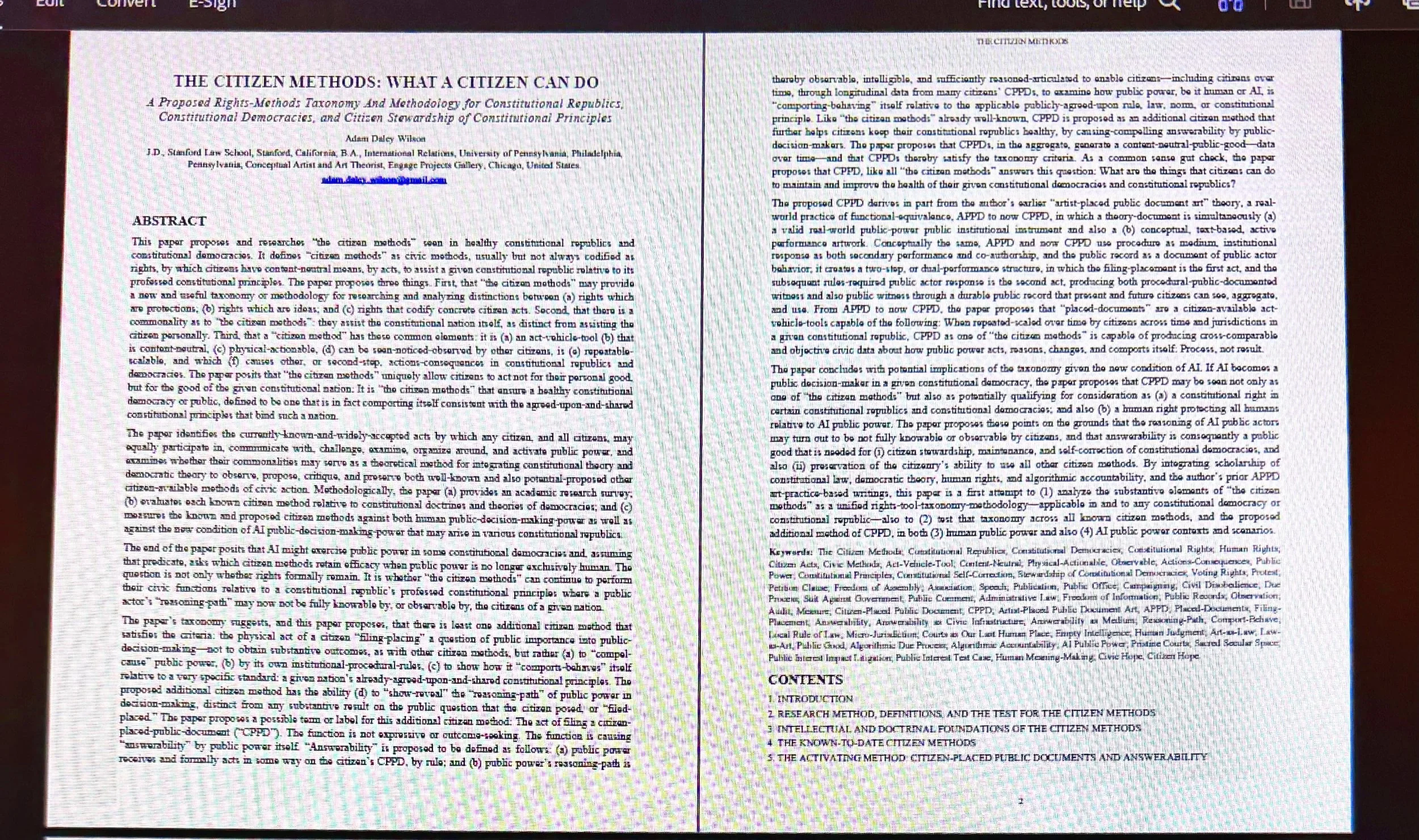
Most recent pre-published paper on SSRN (The Social Science Research Network): “The Citizen Methods: What A Citizen Can Do”
Downloadable .pdf of most recent paper
Theory-Related Performance Art Pieces and Happenings
Several of Daley Wilson’s published and developing theories arise from, or have been tested through, performance, happenings, legal acts, and the placement of artworks within public institutions. Selected works include:
If You Let Yourself Think About It (Theory Art Piece 1). The artist’s physical act of placing a VARA-qualifying text-based visual artwork concerning a social-justice legal theory of first impression in the United States within the supreme court of a state, causing the justices to become both audience and actors in a happening about journalism as art and legal theory as art, 2023–2024.
Theory As Art, Journalism As Art, Law As Art (Theory Art Pieces 2, 3, 4). Ongoing placements of VARA-qualifying text artworks within judicial branches and courts, each causing happenings within courts concerning journalism as art, law as art, and theory as art, 2023–2026.
Look At What We Have Created II. Live creation of a personal-writing-system painting and happening with roughly 20 viewer-participants during Daley Wilson’s second solo show, concurrent with EXPO Chicago, 2023.
Do You Own Conceptual Ownership? Four-day performance incorporating video, installation, a tangible art-ownership experiment, and a conceptual social-justice ownership experiment. Guest artist project by invitation, The Other Art Fair New York, November 8–11, 2018.
Some Feelings And Thoughts I’ll Have Any Second. Four-day performance with installation and conceptual video, The Other Art Fair New York, November 18–22, 2017.
Look At What We Have Created. 12.25-hour performance walk through New York City, overnight, playing six audio tracks from the artist’s backpack and creating layers of words from academics personally known by the artist discussing subjects ranging from mass incarceration to LGBTQ+ rights, until the overlapping audio rendered the spoken words meaningless, November 22–23, 2017.
